Why understanding driver behaviour, traffic patterns and other cues keep us safe
When someone talks about motorcycle riding skills, many picture operating skills: clutch-throttle control, shifting gears, emergency braking, swerving, leaning, and taking corners. But the longer I ride the more I believe it has less to do with having the skills to get yourself out of trouble and more to do with keeping yourself out of trouble.
Even with motorcycle operating skills well mastered, understanding driver behaviour and psychology (what they do and why), having situational awareness (how traffic patterns telegraph what is likely to happen) and knowing how to use that data to put your bike at a speed and in a location that will minimize your risk are all critical.
New riders have more not-at-fault accidents
One of my favourite young racers, I’ll call her Kay, started riding when she was 5 years old—maybe younger. She won so many races and trophies that she was allowed to race in an adult racing series when she was 14 years old where she promptly podiumed in her first year. By all accounts she is both an expert and world-class rider. But, NOT necessarily on the road. When she turned 16 and applied for her road license (if she did) few road riders would be a better rider from a skills standpoint, but many would far surpass her from a road strategy, traffic awareness, and road safety perspective. With her drive and passion for riding she probably is a great road rider, too—it doesn’t matter—the point is the same: riding skills and road-riding judgment are different skills.
I have never met Kay, but I have met many young people who are at the start of their riding adventures. It has always caused me some trepidation. Without having any on-road driving experience, they were going to go out onto the road to perfect their operating skills while trying to learn driver behaviour and traffic patterns. YOWSER! That’s a lot to learn all at once—especially when one mistake can be so devastating. One could almost make an argument (which would be fought against tooth and nail by all motorcycle manufacturers) that potential riders should require one year of on-road car driving experience before they throw their leg over a bike. New drivers and riders have more not-at-fault accidents than anybody else, not because they are bad drivers or riders, but because they have not as yet developed the understanding, judgment, or strategies they will need to keep themselves safe. I’m not recommending this but it is an interesting thought experiment.
Brake lights should have been a good clue
Judgment is borne of awareness and awareness is the result of experience. If you are oblivious to what is going on, then making a decision with good judgment is a moot point. I remember riding on the highway one sunny clear day. I was riding at a speed that wasn’t quite legal, but below which would have caused traffic congestion and frustrated drivers behind me—in other words, a safe highway speed. I was keeping a good two seconds behind the vehicle in front of me, and I was watching far into the distance where I espied brake lights. I eased up on the throttle. At about the same time, a sports bike WHOOSHED past me in the passing lane and did not let up. As I approached the backed-up traffic, I saw that the sports bike had to bail onto the shoulder to avoid rear-ending the car now beside him. I wondered how I had so easily seen the situation unfolding while the sports bike rider seemed oblivious. Riding safely takes knowing how cues give you advanced warning of what traffic scenarios could unfold. And I have to say, brake lights up ahead is a pretty easy one to read. Even so, I see this type of behaviour all the time from cars and motorcyclists alike.
A skilled rider and a smart rider may be different
There are different kinds of good judgment. Once, while riding across the Yellowhead Highway west of North Battleford, Saskatchewan, I ran into hurricane winds and rain. Because a fully loaded adventure bike with side cases and top box acts like a sail in the wind, I had to continuously lean my bike to counteract the high winds. But it wasn’t enough. When a gust came, instead of standing my bike up for a moment after which time I could re-lean the bike, it just pushed my leaned-over bike across the wet pavement and I had to hope the gust would stop before I was off the road. I took the next exit and parked my bike until the rain stopped. The high winds dried the roads quickly, and I was able to continue to North Battleford. The morning had been gruelling. I was exhausted. And it looked like more rain was coming. As I crossed the bridge going over the North Saskatchewan River I was hit by a wind gust so hard I said out loud: “Oh shit, I’m going into the river.” I needed to put my bike where it needed to be to keep me safe, and this time it was off of the road entirely. I quit for the day, a little shaken, at about 1:00 pm. It’s not what my schedule demanded, but it was good judgment.
Riding safely also requires understanding what is going on inside drivers’ heads. During rush hour, many drivers are trying to get to work, get home, or pick up their kid from karate. If they are trapped behind a turning truck, they become impatient. The instant they think the next lane is clear, they will dart out to pass. A neophyte motorcyclist who sees that same open lane and thinks, “Hey, perfect! The lane is open and clear. I’m going to rip up there and pass all the cars,” is riding on the edge. When the car pulls out and gets hit by the bike, it will be the car driver’s fault. The rider can tell him that as he flies over the hood of the car on his way to the hospital. Me? I’d still do what our rider did, but I would do so slowly, keeping careful watch on the front tires of the cars in the queue. Same strategy, different execution.
Being a contrarian
Staying visible is oft-given advice. Because I am a bit of a contrarian, I’d like to throw in that sometimes being hidden is the right call. For example, I’m riding in the right lane and up ahead, in the centre lane is a large truck which I can just see past to the oncoming car waiting to turn left at the intersection. Staying where I am is not an option because once the truck passes, the car might, failing to have seen me, turn. Some might advise me to move into the centre lane so the car will see me more readily. I’m not saying that isn’t an option, but what I would likely do is twist the throttle to move myself up to the right side of the truck where I would be completely protected. Then it doesn’t matter if the car sees me or not. I’ll be through the intersection and past the truck and safe. I definitely would NOT stay in the truck’s blind spot, of course.
But if there is a car nosing out to turn into my lane from the right, that changes things by adding an additional hazard. Slowing down and easing my way into the centre lane might be a better choice in that circumstance. But what might work one time isn’t necessarily the best option the next time. Road strategy is not only the result of being able to predict how things unfold and what drivers might do, it is also the result of continuous scanning and evaluating. The point isn’t to remember specifics, but to understand that road strategy is dynamic.
A little dipsy-doodle
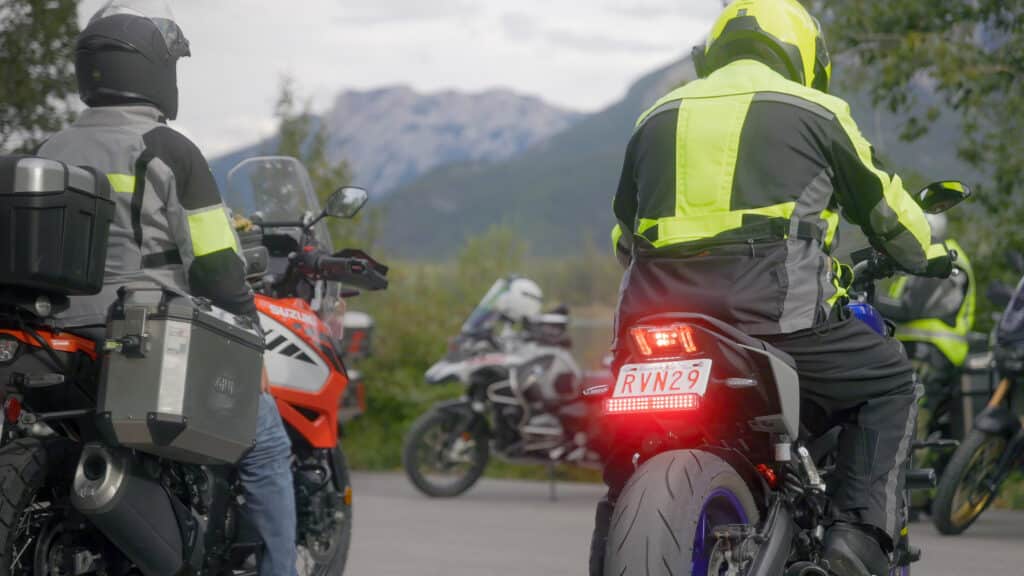
I don’t care what people think. When it comes to my safety I do what works. Sure I might look like Big Bird on a bike, but if high-viz clothing works, I’ll wear it. This applies to road strategy, too. An example of this is when I am approaching an intersection and I can’t get a read on whether the left-turning vehicle’s driver has registered me. If I am riding in the centre lane, I might switch lanes to be in the outer lane, further from the turning vehicle. And, even when I get there I may continue with a little dipsy-doodle with rapid countersteering actions because movement attracts attention. Sure, the driver behind me will probably think I’m loony tunes, but I always remember, he understands the world from a four-wheel perspective, not a two-wheeled one. He doesn’t know why I am doing it. He isn’t used to not being seen in intersections. And he has a cage and an air bag, if things do hit the fan.
It might take new riders a while to discover that drivers have limited attention spans. The consequences of this can be catastrophic so we have to understand it. The first thing to note is that it is not because they are bad drivers; it is because they are human.
I have experienced this many times. While riding on a multi-lane divided highway, a car will pass me in the left passing lane. Then, before even finishing the pass, will change lanes right back into me. “Heh buddy, you were passing me about one second ago. Did you forget I was there already?” The answer is YES! There are two concepts in psychology that explain this. The first is Attribute Amnesia which basically states that once a goal is achieved, the detail required to complete that goal is dumped from the brain. The second is one we’ve all heard before: Out of sight, out of mind. Once he gets past you just enough he simply forgets you’re there—especially if you end up in his blind spot.
We know to avoid blind spots but heck, he was speeding past you, you expected him to keep going, not to try to take you out. These kinds of situations are worth noting and remembering. When a car passes me, I will slow down so it gets completely past me and I won’t be in his blind spot. When he changes lanes it is both expected, and more importantly, I am not there. It is pre-emptive risk management. And that approach is a great way to protect you from a lot of things. We should not have to do it. But we do.
A pleasant surprise. Who woulda thunk it?
The effects of some road strategies are not obvious. Take the two-second following rule, for example. I was taught to do it in every riding course. I learned what can happen empirically. In particular, I noticed that when I left a minimum of two seconds of space behind the vehicle in front of me, I would soon have a vehicle following me also leaving two seconds of space. Surely this was just an oddball coincidence. But I was wrong.
I, as I will do, did a little research. It turns out that by creating and maintaining the two-second space in front of me, cars following would react similarly. This was not happening by chance. There’s an interesting principle at work here called The Mirror Neuron Effect. Human brains are wired to take cues from what’s happening around them. When I left a calm, consistent, two-second gap, the driver behind me accepted that speed and following distance as “normal” and they would settle into the routine rather than feel the need to rush. It does not happen every time, but you’d be surprised how often it does. This makes my ride safer—no question. Keep in mind, it goes both ways; if you ride aggressively, you provoke an aggressive or panicked reaction from the traffic around you, making your ride less safe. Just sayin’.
To me, riding well is a combination of keeping my riding skills in peak shape while at the same time continuously learning driver behaviour (how and why they do what they do) and traffic patterns (how and why they can foretell what will happen out there). From this I develop strategies to deal with what I might encounter, all the while being ready to change it up based on new information in real time. Most importantly, I continue to develop the situational awareness and judgment I need to keep myself safe.
So get out there, be visible, stay safe, and keep learning.
– John Lewis

John is a passionate moto-traveller and motorcycle enthusiast who enjoys sharing stories that inform, inspire, and entertain. Specialising in motorcycle touring, safety, travel, or just about anything motorcycle-related, John’s insights, travels, and experiences have been featured in national magazines such as Motorcycle Mojo and The Motorcycle Times, as well as on various blogs and websites. When he is not riding or writing, he works as the service manager at a boutique motorcycle shop where he’s always ready to share a story or helpful tip.