
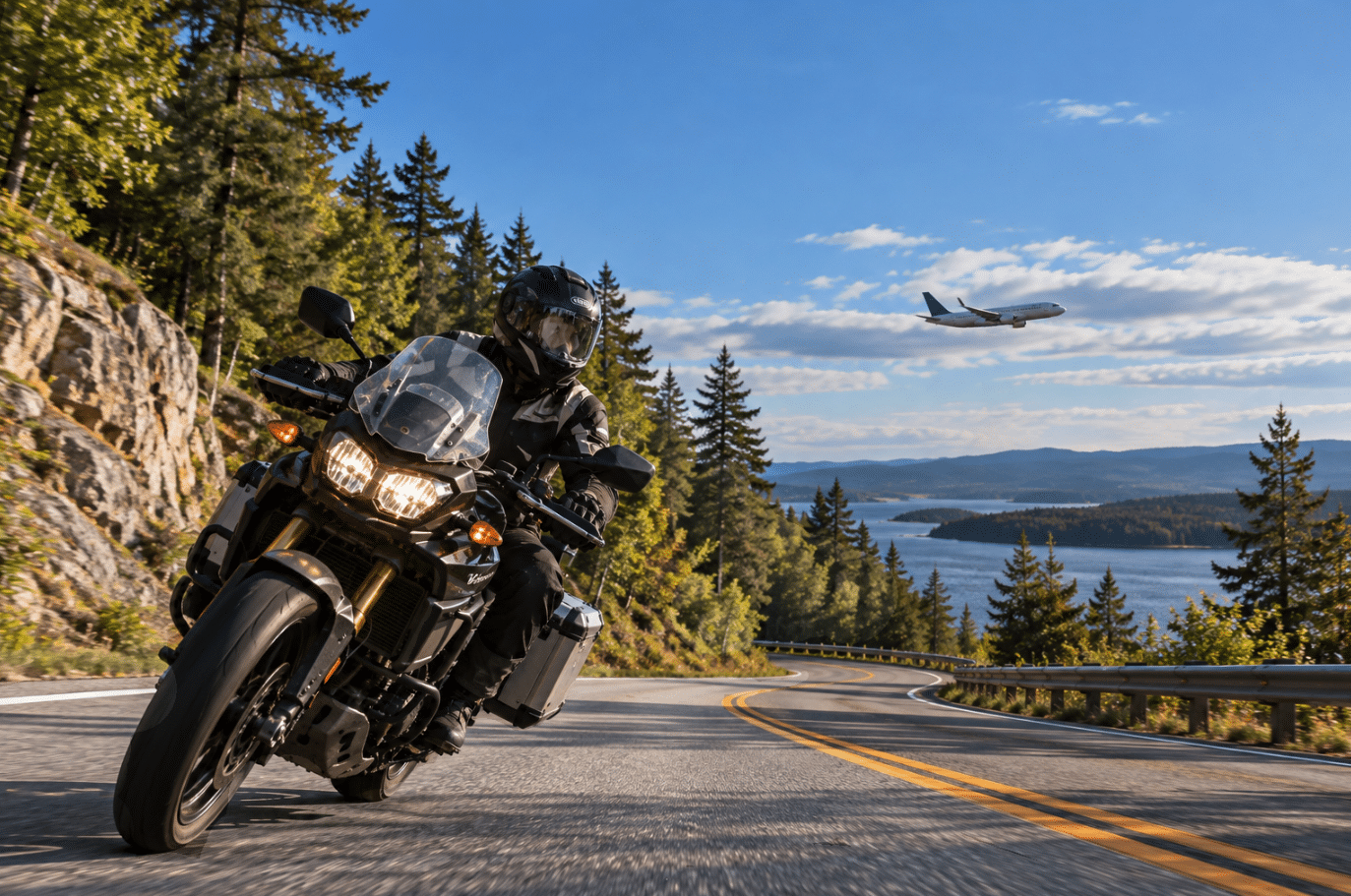
How many can you handle at once?
When it comes to motorcycling, the only model that works is the one that works for you. The UK has their model (IPSGA: Information, Position, Speed, Gear, Acceleration), the Motorcycle Safety Foundation has their model (SEE: Search, Evaluate, Execute), and Canada has theirs, too (SIPDE: Scan, Identify, Predict, Decide, Execute).
But, these models don’t seem to capture how I ride, including how I manage attentional capacity when I am faced with multiple hazards. Attentional capacity (your ability to manage a number of things at once) works like a funnel. If there is too much going into the funnel (too many competing demands) it will overflow—your attentional capacity will be exceeded. The linearity of traditional models seems to suggest a one at a time handling of each hazard. But the real world doesn’t co-operate. I ride so I can manage multiple competing demands in real time.
Some people like to build models: planes, trains, automobiles, or motorcycles—even full-size ones you get to ride afterwards. I’m not handy that way. I like to build mental models, visualize things, and convert complex ideas into simple representations that can help me understand things in new ways. For years now I have been doing this with motorcycling. If I am lucky, what I come up with describing how I interact with the riding world might help you, and make you a safer rider. But, and there is always a but, caveat viator—traveller beware—I am not a certified instructor. Do your own due diligence, take only what you think will help, and leave the rest behind.
Let’s explore this in a scenario I came across. I was travelling south down one of my favourite twisty roads. The curves were tight and there wasn’t a straight stretch of road available for passing, which is how I ended up with a tailgating sports car on my rear. I approached an uphill limited-view left curve. As I could see through the curve I saw three ATVs parked on the right shoulder at the top. I chose my entry speed and my line. I also saw that the centre of the lane had a sand and gravel hazard. As an added complication, as I took my line and ascended the hill a dump truck came screaming around the corner across the centre line.
This scenario is neither good nor bad. But depending on the rider, the same sequence of events might have a considerably different outcome. Some riders may exceed their attentional capacity leading to a crash. Others may ride through it quite effortlessly.
Rider B travels south down the same twisty road. Because the curves were tight and close together with no straight stretches available for passing, B acquired an aggressive tailgating sports car. This annoyed B so it consumed some attentional capacity. Rider B approached the uphill limited-view left curve. B could see through the curve and saw the three ATVs parked on the right shoulder at the top. No big deal because B’s line (outside inside outside) would travel across to the other side of the lane. Nothing here to tax B’s attentional capacity. B chose a sporting entry speed and line. B could also see sand and gravel in the centre of the lane but intended to be on the far left of the lane so not much to worry about. Well, not until a dump truck came screaming around the corner across the centre line. B had to make an emergency countersteering move to prevent a collision putting it right in line with the sand and gravel—the bike at a serious lean angle at risk of losing traction. >>>TILT: ATTENTIONAL CAPACITY EXCEEDED. CRASH IMMINENT!<<<
Furthermore, once B exceeded their attentional capacity, panic mode can be triggered, leading to incorrect rider behaviour, or as Keith Code wrote in A Twist of the Wrist II, the emergence of automatic survival reactions. E.g., rolling off the gas when you should keep it constant, death-gripping the handlebars, target fixation, improper braking, etc.
Now, let’s look at how I have revised the model to accommodate how I ride.
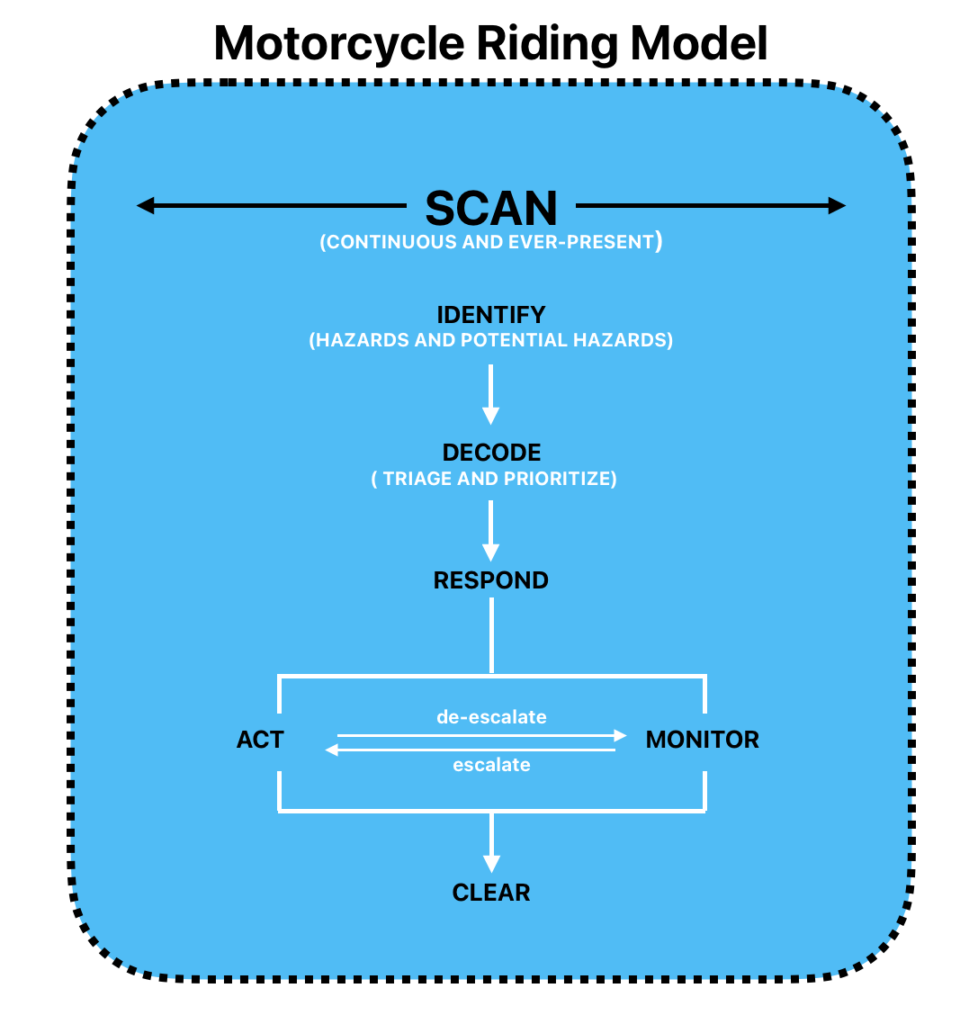
Continuous Scan: needing to be aware of the environment doesn’t stop while you’re dealing with something you’ve already identified. You are always scanning.
Identify: what’s important is that we also identify potential hazards. Knowing about them in advance helps us manage our attentional capacity.
Triage and Prioritize: with several live hazards, the key question is how much of my attention does each deserve right now?
Act or Monitor or Clear: this lets multiple hazards remain alive without all consuming equal bandwidth. Ongoing scanning could change their status as circumstances change.
When Rider B encountered a multitude of hazards at once—the tailgater, the gravel, the ATVs, and the screaming dump truck—Rider B crashed, not because they lacked skill, but because their attentional capacity was exceeded.
It is worth stopping here for a moment to look at what that actually means. Our attentional capacity is finite. We don’t suddenly get more of it because the situation has become complicated. But neither does every hazard place the same demand on it. Something requiring immediate action deserves considerably more attention than something that merely needs to be monitored. Something that has ceased to be relevant should consume almost none.
That is why I think Act, Monitor and Clear matter. They aren’t just three boxes at the bottom of a flow chart. They are a way of allocating a finite resource. I can be actively dealing with one hazard, monitoring two others, and clear another when it is no longer relevant. Continuous scanning may uncover something new or tell me that something I was merely monitoring has suddenly become considerably more important. I triage again. Priorities change.
And hazards don’t exist independently of one another. The dump truck didn’t simply become one more item on a list. Its arrival changed the importance of things I had already identified. The gravel that was merely something to avoid, for Rider B, suddenly became a dangerous hazard they had to ride across. The parked ATVs could affect the available escape route. The sports car behind could become considerably more relevant if the bike needed to shed speed quickly. One event can therefore change the attentional demands of several hazards almost instantaneously.
Looking farther ahead is critical. It isn’t merely about seeing hazards sooner. Looking well ahead can prevent future demands from disproportionately affecting attentional capacity. This helps maintain the attentional capacity already available.
Pilots have a problem that will sound familiar. Most of the time flying is relatively routine. But when things go wrong, they can go wrong quickly and several things can demand attention at once. A pilot, like us, doesn’t suddenly acquire more attentional capacity because an engine has failed, the weather is deteriorating and something else in the cockpit has started making an unpleasant noise. What happens is that his attentional capacity is consumed, leaving less to handle new issues.
Aviation has spent decades developing ways of dealing with precisely this problem. Well-established procedures and protocols have been established to assure safety.
Aviation’s systemic logic applied to motorcycling gives rise to a systems approach to riding. Let’s go back to the hill.
Standard operating procedures (SOP): these become my non-optional riding practices: sight-distance rule (always travel at a speed that allows you to stop in the distance you can see to be clear on your own side of the road), following distance (two-second rule), looking ahead (twelve-second rule), line choices, speed, etc.
Practised emergency procedures: emergency braking, countersteering, obstacle avoidance: responses you’ve practised so you’re not inventing them during the emergency.
Recognizing and anticipating high-workload situations: looking well ahead and assessing before entering a limited-view curve. You’re trying to deal with predictable demands before they stack.
When a motorcyclist fails to follow standard operating procedures, i.e., they ride by the seat of their pants, they may face real-world consequences. And although the scale may be different from that of an airline failure, in my opinion, they’re just as catastrophic.
Let’s go back to the hill.
Rider C faces the same scenario as Rider B. C too has a fixed attentional capacity. The difference is in how it is managed, the demands being placed upon it, and how C mitigated their situation by the decisions they made beforehand.
The sports car is still there. It has been identified and unless its behaviour changes, it can be monitored. The ATVs have been identified as a potential hazard. They affect the amount of lane available, but at the moment they require monitoring rather than action. The gravel is expected. It is accounted for in the chosen speed, line, and lean angle.
The systems approach to riding has done its work. When Rider C meets new hazards they don’t substantially add to the load on their attentional capacity. C sees hazards and decodes them in real time. And C has developed systems and protocols and checks and balances to keep their riding optimal and fun whilst maximizing their safety. But Rider C ain’t no saint! Clear view of the curve and the road ahead and they’ll twist the throttle, get some lean, and scream through the corner.
That, to me, is the important difference. Systems riding has reduced some of the demands by establishing how to approach foreseeable problems. The model I have adopted helps me to manage the attentional demands of the hazards that are actually present. If I were C, I would still be dealing with the same imperfect road, the same truck, the same gravel, the same ATVs and the same impatient driver behind me. Nothing has increased my attentional capacity. I have simply done a better job of keeping the demands upon it from exceeding what I have available.
Which brings me back to why I started building another model when motorcycling already has plenty of them. It wasn’t about replacing SEE, SIPDE, IPSGA or anything else. I was trying to understand something I couldn’t see in them: what happens inside my own head when I ride; how I handle several hazards at the same time; how I manage how one thing requires action, another can be monitored, another can be cleared, and why those priorities may change from one second to the next; and how and why I often deal with quite dangerous situations without even a rise in adrenalin.
Building the model captured how I was already riding. And what I learned from it led me towards a more formalized systems riding approach: not waiting for each problem to arrive and then demonstrating how skilfully I could solve it, but arranging the way I ride so foreseeable problems place as little unnecessary demand on my attentional capacity.
The two work together. A systems riding approach helps me minimize the attentional demands I face. The motorcycle riding model helps me manage and prioritize the demands that remain. Neither gives me any more attentional capacity.
Most importantly, it helped me realize that the protocols I have available to me are not optional. Just like a pilot, they need to be in place for every ride. Because, at the end of the day, good riding isn’t simply about having better skills, seeing more hazards, or becoming extraordinarily good at juggling everything the road throws at you. It is attentional capacity management, just like an airline pilot. Our attentional capacity is finite. It’s up to us to manage it when competing demands are asking for its attention.
Get out there, be visible, stay safe, and keep learning.
– John

John is a passionate moto-traveller and motorcycle enthusiast who enjoys sharing stories that inform, inspire, and entertain. Specialising in motorcycle touring, safety, travel, or just about anything motorcycle-related, John’s insights, travels, and experiences have been featured in national magazines such as Motorcycle Mojo and The Motorcycle Times, as well as on various blogs and websites. When he is not riding or writing, he works as the service manager at a boutique motorcycle shop where he’s always ready to share a story or helpful tip.