We’ll let you know, but the long way round
Motorcycling pundits (who are these mysterious people?) often tell us that most people who purchase ADV bikes never actually do any adventure riding. In his book, Adventure Motorcycling Handbook, Chris Scott asks the question, “What exactly is adventure motorcycling?” and then goes on to say that for the purposes of his book “… it involves a challenging, unsupported journey into the wilderness or a significantly strange country.” Is that what the motorcycling pundits are thinking too? What if you go to a strange country but stay on the tarmac? Is that adventure riding? Or, do you also need to be standing on your foot pegs navigating tricky unpaved terrain—no doubt abutting a motorcycle-swallowing abyss—with bandits lurking and sautéed snake awaiting you for dinner? For his book, Scott can define it any way he wants, but I think it’s a little more complex than that.
For example, if you are a former motocross competitor, the hardest riding conditions, wherever they might be found in the world, may not be challenging to you. If you’ve lived in Africa or the Yukon, lions or grizzly bears may not be much of a worry—sure, something to be reckoned with, but not something that would send shivers of fear up and down your spine as it might do to the rest of us. If you’ve been adventure riding for so long it has become commonplace, are you still “adventure” riding when the “strangeness” and sense of “wilderness” have gone? So, you see, defining what is and what isn’t an “adventure” just isn’t that easy. An adventure for one may not be for another. It depends on you, your experience, your risk tolerance, and what you see as an adventure. As for “adventure riding”, I’ll let others decide.
If you’ve seen Ewan McGregor and Charley Boorman in the series Long Way Round, you may think that this is what adventure riding and adventure touring is all about. But according to Scott’s definition they don’t qualify because it was supported. Their support went from having a camera crew in a van to having medical staff and security staff along at some points. Most paid-for adventure trips you might book will also be supported. Does that make them “not” adventure motorcycling? Does it remove your sense of adventure?
Have you ever been so afraid that you nearly wet your pants? When I was about eight years old my parents took me to the Dorset Lookout Tower. It seemed like a good idea for a family outing—in theory. I got about two-thirds of the way up and became paralyzed with fear. It turned out I was petrified of heights—who knew? But slowly, on my hands and knees, and despite my fear, stair by stair I crawled until I reached the lookout deck 142 metres above the Lake of Bays. Was that an adventure? As an eight-year-old, climbing that last third of the lookout tower was probably the biggest adventure I’d ever had.
When I did the police motor-officer certification course—which I took only days after a twenty-plus-year hiatus from riding—our warm-up on the second day was a follow-the-leader exercise. The instructor led eight motorcycles/riders into a tight circle before he turned the other way to complete the figure eight. He then yelled, “Alternating motorcycles from each direction cross in the middle one at a time—and don’t bloody hit each other!” So there I was, only days back on a motorcycle, riding a police rodeo figure-eight demonstration maneuver with nine bikes in all, thinking, what the hell have I got myself into? It was just a training course, but I definitely didn’t think I’d be doing that at all, let alone on the second day. It was bloody harrowing.
But I’ll give Scott this: risk and adventure go hand in hand. He alludes to this in his definition by using words like “challenging” (does he mean you could crash, or ride into an abyss?) and “wilderness”—I’m imagining hungry lions or grizzly bears circling camp looking for their next meal. (“Grrrr, the man in the yellow Gore-Tex looks tasty.”) But risk, like adventure, is relative.
In my early twenties, when I had just started caving (exploring wild underground caverns), I was asked if I wanted to learn how to become a vertical caver—a cave explorer who is able to explore caves only accessible by rappelling into pits ranging from a few metres to hundreds of metres. My initial response was, “Thanks guys, but you know, heights aren’t really my thing.”
After a little cajoling and having my new friends explain that some great caves existed beyond the smallest of descents, I was persuaded to go out and learn the ropes. (Both literally and figuratively.) Addressing my fear of heights (lurking in my subconscious from my childhood memories) made vertical caving a real adventure. After a few practice sessions, I was told that I was ready and was invited on a vertical caving trip to West Virginia. Little did I know that they would take me to the two deepest cave descents in the region—one of which was called Hell Hole, and the other Suicide Falls. (Very funny guys.) I was later to learn that the invitation had nothing to do with my readiness and everything to do with the fact that I was the only person with a reliable car. (Haha again guys.)
I went on to teach vertical caving and to rappel drops of more than 350 metres (>1150 feet). How did I get from being the near-pants-wetting eight-year-old to becoming an experienced vertical caver comfortable rappelling depths equal to the height of the pod on Toronto’s CN Tower? Simple! I entered the adventure continuum at one place and through years of practice, experience, and hundreds of cave descents, I ended up further along the continuum. Adventure is a continuum. You don’t have to wait until __________ (whatever you’re waiting for) to have a motorcycling adventure. Just jump in wherever you’re comfortable and before you know it you’ll be having adventures you never thought possible.
For some, putting a leg over a motorcycle for the first time might be a near-pants-wetting experience. Especially if you’ve always wanted to ride but have been scared off by the plethora of people and media that all but say that if you’re going to ride a motorcycle, you might as well go ahead and sign your donor card. Kudos to anyone who faces their fear and gets on a motorcycle and takes their first unsupported trip through the strange high-risk land called city traffic. David Hough, a prolific motorcycle writer, wrote in one of his books that wherever in the world he had ridden, the most dangerous places were always the cities—because of the traffic. Is that first trip around the block an adventure? I’m sure to a new rider it is.
Some people get their motorcycle license and jump into the deep end by going on trips that many of us would want to have more experience under our belts to do. I met one such person at the Horizons Unlimited Ontario event. As one of the presenters, she shared her journey from Ottawa to Patagonia and back, and she had done the whole trip with her M2 license. She did not, at the time of her trip, have a full motorcycle license. For her, there was certainly some challenging riding. I recall she broke both ankles, in separate incidents, along the way. She was delayed, but as soon as she could, she carried on.
Mostly, what I recall is the gumption it took for her to just get up and go. She was very inspiring. And she was a regular Joe—maybe a teacher, a nurse, or a corporate CEO, but certainly no Ms. Sir Edmund Hillary. She was, for all intents and purposes, just like me. She had simply entered the adventure continuum and, along with her husband, away she went.
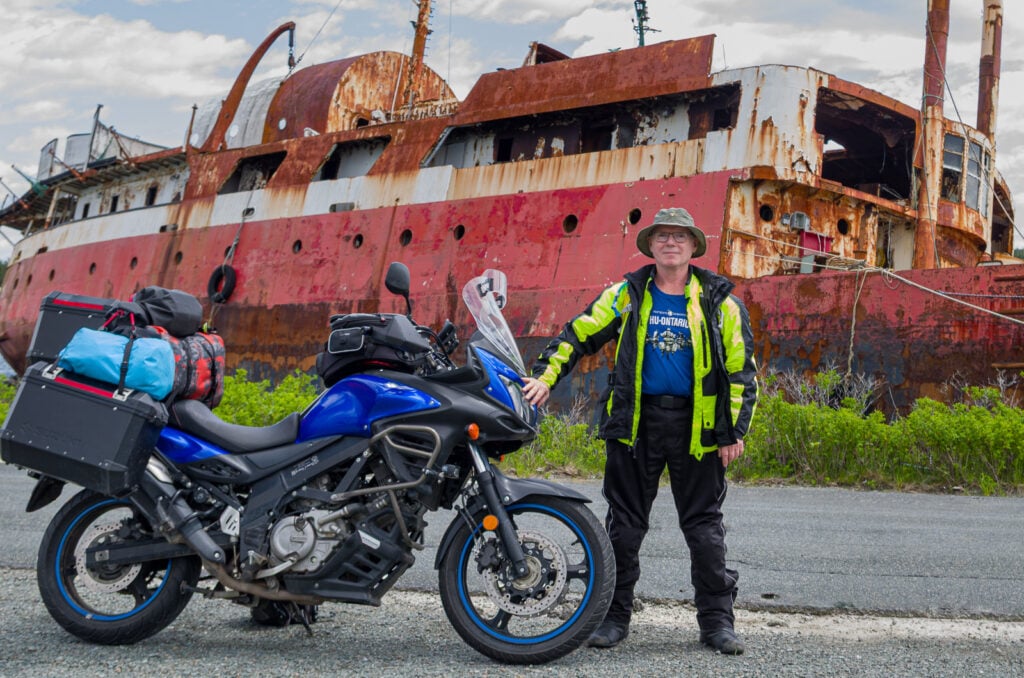
When I started riding I didn’t know I would be exploring Canada on a series of solo trips that gradually got longer and bolder. I haven’t ridden around the world—yet. It doesn’t matter. I’m in the adventure continuum and who knows where I’ll end up. Am I an adventure rider? By Chris Scott’s definition, probably not. But I don’t care. I do what’s in me to do, and for me, it’s an adventure!
There is no right way. For you, your way is the right way. It could be your first solo weekend tour, your first cross-country trek, or your first trans-Mongolian crossing. It doesn’t matter. Do what you need to stay within your risk tolerance and fuel your sense of adventure. Enter the continuum where you need to, then go have an adventure. Your adventures will get bolder as you go!
Be seen, ride safe, and get out there and have an adventure.
– John Lewis

John is a passionate moto-traveller and motorcycle enthusiast who enjoys sharing stories that inform, inspire, and entertain. Specialising in motorcycle touring, safety, travel, or just about anything motorcycle-related, John’s insights, travels, and experiences have been featured in national magazines such as Motorcycle Mojo and The Motorcycle Times, as well as on various blogs and websites. When he is not riding or writing, he works as the service manager at a boutique motorcycle shop where he’s always ready to share a story or helpful tip.