
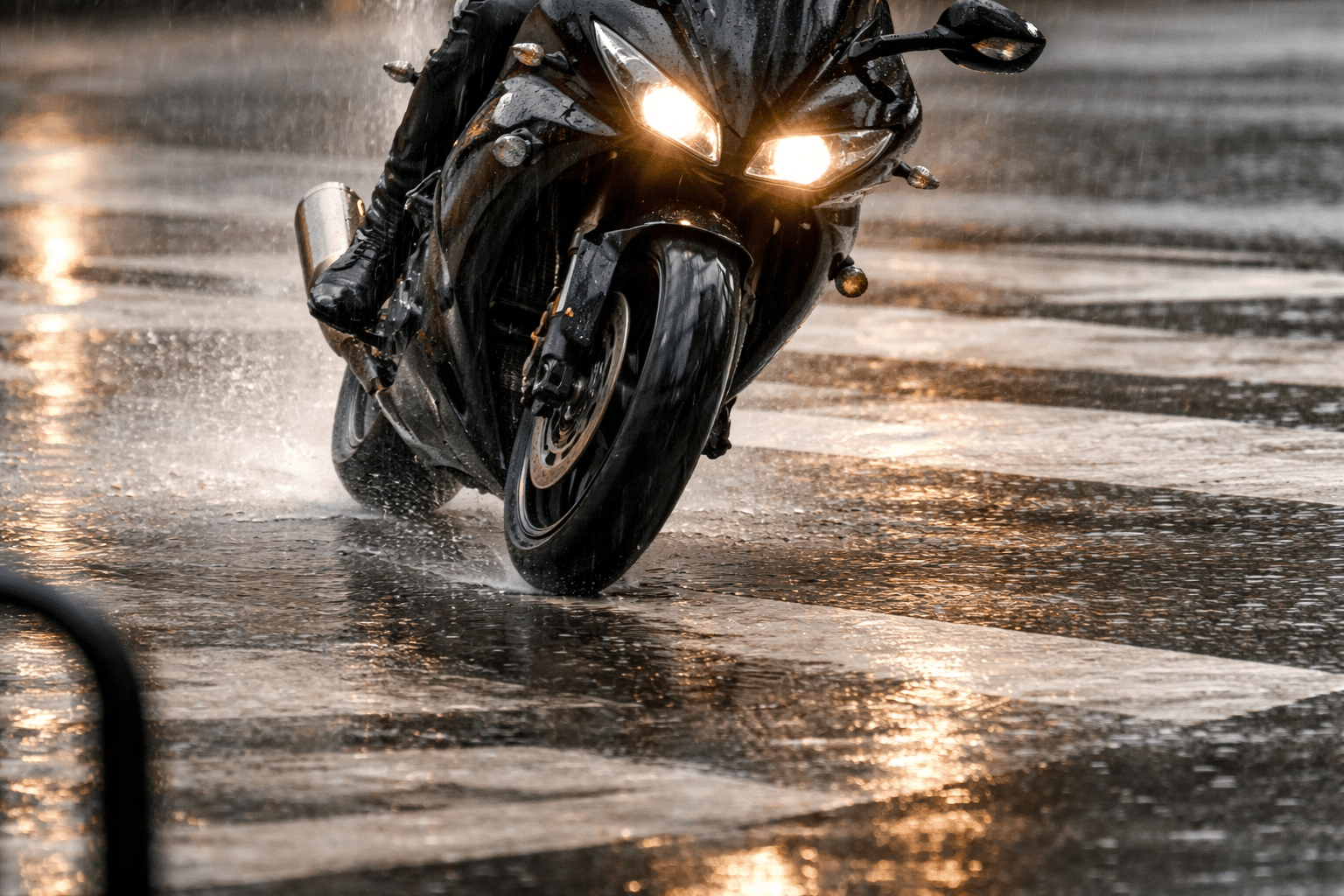
Why You Should Hope It Rains On Your Course Weekend
Most new riders think rain will ruin their motorcycle licensing course weekend. Wet pavement sounds like the last thing you want when you’re trying to learn something new on two wheels.
“Is it too late to cancel?”
Hold on! From a training standpoint, you’ve just won the lottery. I know. It happened to me, and my thoughts were the same as yours. And no, I didn’t know I’d won until long after the fact.
After a long hiatus from riding, I found myself back on a motorcycle in a church parking lot in Saanich, British Columbia. I had borrowed a 2006 BMW GS to do an intensive riding course. Larry, a police motor officer, was asked to make sure I knew my way around the BMW before the course started. We were scheduled to go out for a one-on-one session at 10:00 a.m. Sunday.
Ten a.m. Sunday came. And it was raining. Not a light drizzle. I mean cats-and-dogs raining. The course was starting Monday, so I donned my rain gear, and out in the rain I went. Argh!
For several hours Larry simply rode ahead of me and I followed. We were practicing police riding patterns, any one of which, had I been tasked with doing on my own—especially in the pouring rain—would have scared me to death. But he didn’t teach. He just said: FOLLOW ME! (I don’t think he was that happy having agreed to take me out on this foul weather day—thanks Larry!)
There wasn’t much time to stand around discussing traction theory. Larry just kept moving and my job was to keep up.
We practiced starting and stopping.
We practiced tight turns.
We practiced slow circles and figure eights.
And it kept pouring and pouring and pouring.
What surprised me most was what didn’t happen.
I did not lose traction even once. The pavement was slick with water and there were puddles everywhere, yet the motorcycle behaved exactly the way it was supposed to. The tires held. The brakes worked. The bike leaned and turned normally.
Had I stopped beforehand to think about it, I probably would have imagined the opposite—that the moment I leaned the bike in the rain it would slide out from under me. But following Larry around that rainy parking lot didn’t leave much time for speculation.
I simply did his drills.
And the motorcycle simply worked.
Rain gives immediate feedback. Smooth on the controls or I knew I’d be down. But I never went down.
Rain is a great teacher. Somehow doing it right became automatic. There’s actually a training principle behind that. It’s called high-stress learning. We perform better with a certain amount of pressure. When we’re soaking wet and focused, we learn faster because the stakes feel higher. That level of focus burns the skill into our long-term muscle memory far deeper than a sunny afternoon ever could.
Heh… thanks, rain.
Something else happened that day I didn’t appreciate until much later. Rain quietly teaches riders to be smoother with their control inputs.
If you grab the brake or snap the throttle open, the bike lets you know immediately. The only way to ride comfortably in the wet is to become deliberate—smooth on the throttle, smooth on the brakes, smooth with your steering, smooth with your shifting.
Without realizing it, that rainy parking lot was training me to be a better rider.
Rain also sharpened my awareness of the road surface itself. Dry pavement tends to make riders complacent. In the rain you start noticing details you might otherwise ignore—painted lines, metal plates, railway crossings, wet leaves, patches of debris. Most of the road actually has good traction even in the wet. The trick is simply learning where the traction isn’t.
There is also a psychological effect at work here. Psychologists have a concept called self-efficacy, introduced by Albert Bandura. The idea is simple: confidence does not come from encouragement. It comes from successfully completing a difficult task or exercise.
Once you brake hard in the rain and the motorcycle stops exactly the way it should, your brain records that experience. Once you lean into a wet corner and come out the other side upright, it records that too.
Instead of wondering whether you can handle the situation, you know that you can—because you already have.
There’s another psychological mechanism at work as well: habituation.
When the human nervous system encounters something unfamiliar, it reacts with heightened alertness. Heart rate rises. Muscles tense. Attention sharpens. But repeat the same experience enough times without a negative outcome and the nervous system stops treating it as a threat. Rain stops feeling dangerous and starts feeling normal.
After finishing my time in Victoria, I set out to ride my newly purchased V-Strom back to Toronto. Like most riders beginning a long trip, I hoped for good weather.
Instead, it rained. Not once or twice, but most of the way across the country. Nine of the ten riding days were wet. Under different circumstances that might have been miserable. Long hours in the rain can test anyone’s patience.
But something unexpected happened. The rain not only didn’t bother me. I loved riding in the rain.
The motorcycle was predictable. Instead of white-knuckling the handlebars and worrying about traction, I rode naturally. The bike behaved exactly the way it had in that soggy parking lot back in Saanich.
The roads were often empty. The air after a rainstorm was remarkably clean. Mountain views appeared sharper once the haze disappeared.
What I had initially assumed would be a miserable ride turned into something quite enjoyable.
It wasn’t until months later that the realization finally landed.
That rainy training session had quietly removed the fear of riding in the rain before it ever had a chance to develop.
At the time, I didn’t know anything about psychological theories for overcoming fear or training theories for gradually increasing stress while learning a skill. I experienced them inadvertently.
And I became a better rider because of it.
Instead of spending years wondering how much traction a motorcycle really has in the rain, I learned the answer on day one. My brain had already experienced the motorcycle behaving normally in wet conditions, so when the real-world version appeared on the ride home, it didn’t feel threatening. It felt familiar.
Which brings us back to your course weekend.
Most riders secretly hope for sunshine when they sign up for a motorcycle course. That’s understandable. Warm, dry pavement sounds comfortable. But it doesn’t teach you much.
Rain, on the other hand, removes uncertainty. It teaches you smoother control inputs. It sharpens awareness of the road surface and quietly builds habits instructors try to teach every new rider.
More importantly, it allows you to discover—under the watchful eyes of instructors—that motorcycles are far more capable in the rain than most beginners imagine.
So when the forecast says rain, say, “Bring it on.” After all, you’ll pay the same price for your course as those learning on a sun-filled weekend, but you’ll leave a much better rider.
All because of the rain.
– John Lewis

John is a passionate moto-traveller and motorcycle enthusiast who enjoys sharing stories that inform, inspire, and entertain. Specialising in motorcycle touring, safety, travel, or just about anything motorcycle-related, John’s insights, travels, and experiences have been featured in national magazines such as Motorcycle Mojo and The Motorcycle Times, as well as on various blogs and websites. When he is not riding or writing, he works as the service manager at a boutique motorcycle shop where he’s always ready to share a story or helpful tip.