And what I’m going to do about it in 2026
Damn! The line of cars beside me had stopped to let a car turn left. I hadn’t seen it, so I rode right into its path. Fortunately, even though it was being waved through, its driver had seen me. I was lucky. This time. But—I had let my safety depend on the attentiveness of another driver. And that is how you crash a motorcycle. I knew I was better than that, which is why I wondered: How could I have made such a stupid mistake?
That question is where the real trouble begins, because it leads to an uncomfortable answer: It wasn’t a lack of skill. It wasn’t a lack of knowledge. It wasn’t a stupid mistake. It was something far more ordinary than that. It was my brain doing what brains do—after spending years collecting data about scenarios when nothing bad had happened, it assumes that nothing ever will.
The kind of mistake that doesn’t feel like a mistake—but it can be deadly
A few things made that moment especially irritating.
First, it didn’t feel dangerous at all until it nearly was. There was no drama. No skidding tires. No horn. No “oh my God” moment. If that driver had turned, it would have been a crash that I could have avoided.
Second, it happened in a scenario that looks like nothing. Traffic does traffic things. A line stops. Another lane keeps moving. This is not rare. This is not exotic. This is a sunny Tuesday afternoon.
And third, I had allowed my safety to depend on variables I do not control. And I know better. If I don’t have 100 per cent of the data based on what I can see, I need to proceed with caution.
And, what’s worse, if I hadn’t consciously clocked it as a mistake, because nothing went wrong, my brain would have filed it under the everything-is-fine category once again.
But it wasn’t fine. I was lucky. And luck is an unreliable riding partner.
Intersections already taught me this (and I forgot anyway)
If this feels familiar, it should. I’ve written about it before in a different post.
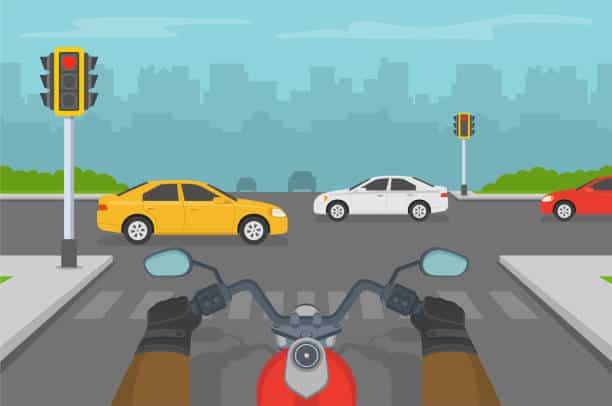
Intersections are dangerous for riders not because they’re rare, but because they’re common. We pass through hundreds of them, and for most of us, nothing happens. So the brain does what it always does when nothing raises a flag: it relaxes.
We don’t consciously decide to become complacent. We don’t say, “Today I will lower my vigilance.” It happens the way erosion happens: slowly, invisibly.
That’s why the “most dangerous time” isn’t when you’re learning. When you are learning you are hyper-alert. It’s later—when your competence is real, your confidence is high, and your brain has quietly collected a large dataset of nothing bad happening.
There’s a name for this
There’s a term for the thinking trap that fuels all of this: Normalcy Bias.
Normalcy bias is a cognitive bias that leads people to underestimate the possibility, scope, or impact of a disastrous event because it hasn’t occurred to them in the past. In short: Since it hasn’t happened, it won’t.
But, on a motorcycle, that’s a problem. First, you can be an unskilled rider and be lucky for years. Second, you can be a highly skilled rider and still have been lucky for years. When normalcy bias makes us complacent we are at risk. Period.
How normalcy bias shows up while riding
The first thing to know is that we are oblivious to normalcy bias. We are not being lazy. It’s just that when things become routine we become complacent.
Because nothing happens, it feels like we did everything right. Sometimes we did. Sometimes we simply got away with it. Because it has worked for us so far—even for years—it doesn’t mean that it will continue.
But we aren’t doing anything wrong, per se. It is a brain trap that tricks us into thinking this way. Normalcy bias is our brain trying to be efficient—an attempt to turn a complex environment into a manageable one. But the road is not a predictable or manageable environment.
Normalcy bias is a thinking trap we can’t uninstall. The brain is going to shortcut, predict, and assume. That’s what it does. It’s our job to throw a wrench in the works so we can overcome the complacency that can arise.
2026 strategies to battle the normalcy bias
1) Re-read one beginner riding book every winter
Not because I need to be reminded what the clutch does, but because beginner instruction is full of things experienced riders quietly stop taking seriously.
Beginners are taught to treat gaps as threats. To slow for intersections. To expect the left-turner. To cover brakes. To leave space. To scan aggressively.
Then we ride for years, get away with minor laziness, and “recalibrate” danger until it feels normal.
Re-reading a beginner book reintroduces the foundational paranoia—without the drama. It resets the frame.

2) Take advanced training early in the season
Spring is when we’re most likely to be rusty and most likely to be overconfident about not being rusty.
Early-season advanced training does two things: it refreshes technique, and possibly more importantly, it interrupts the narrative that riding a motorcycle is just like riding a bicycle.
Because it isn’t. A bicycle doesn’t get T-boned by a distracted driver doing 70 km/h.
3) Institute a personal rule for “screened hazards”
Stopped vehicles create visual screens. Big SUVs create screens. Trucks create screens. Hedgerows, buildings, parked cars, urban furniture (bus shelters, construction signs, advertisements, etc.) create screens. If I can’t see everything, proceed like I’m going to get hit until I can verify otherwise.
4) Use a simple “Why are they doing that?” check
When traffic behaves oddly, ask why. Not as philosophy—as survival.
Cars stopped where they shouldn’t be? Why.
A driver waving someone through? Why.
A sudden gap in a lineup? Why.
That one word breaks the brain out of the “normal story” and forces investigation.
5) Build a personal “boredom alarm”
If I realize I’m riding and not really riding—if my mind is elsewhere—that’s a cue to tighten the scan, reset following distance, and stop coasting on pattern.
Boredom isn’t harmless. Boredom is the doorway through which normalcy bias walks in.
The point isn’t fear—it’s fewer surprises
There’s a fantasy version of “safe riding” where nothing ever happens. Real riding doesn’t work that way. The road is too complex and road hazards are too unpredictable.
So the goal for 2026 isn’t perfection. It’s something more modest and more achievable: fewer surprises, fewer moments where luck did the heavy lifting, fewer times when “nothing happened” tricks me into thinking “nothing could have happened”.
Normalcy bias will always be there. It’s a human feature. But I don’t have to let it drive. Because the day I start outsourcing my safety to other drivers—assuming their attentiveness, skill, and judgment will rescue my mistakes—is the day I’m eventually going to pay for it.
– John Lewis

John is a passionate moto-traveller and motorcycle enthusiast who enjoys sharing stories that inform, inspire, and entertain. Specialising in motorcycle touring, safety, travel, or just about anything motorcycle-related, John’s insights, travels, and experiences have been featured in national magazines such as Motorcycle Mojo and The Motorcycle Times, as well as on various blogs and websites. When he is not riding or writing, he works as the service manager at a boutique motorcycle shop where he’s always ready to share a story or helpful tip.