Lessons I’ve Learned From the Road
I don’t know if you are like me. I think things through. Consider eventualities. And arrogantly and erroneously, think I know. But I don’t. Thinking about stuff doesn’t teach you anything. Experience does.
But, there may be an exception—learning from others’ mistakes. If so, I might be an excellent teacher because I don’t make a mistake just once; I tend to make it two or three times, just to be sure. Then the coin drops. “Okay, got it.”
Here are a few things experience has taught me along the way. If you’d prefer, stop here and go out and make your own mistakes. It can be fun. But it can also be costly. Even painful. It’ll probably be a better teacher than I am. Otherwise, sit back, grab a beer, and join me as I recount some of the lessons I have learned from the road.
Reset
(Or, some things I didn’t know before I started my cross-country journey)
Within three weeks of returning to riding, I bought a Suzuki V-Strom in Victoria, British Columbia, rode to Port Hardy at the top of the island and back, and then set off for Toronto. It took me ten days—I wasn’t in a rush—and it rained nine of the ten days I was on the road. Talk about jumping in feet first.
Lesson one. Going from a short day ride to daily seven-hour rides takes a different mindset. Hell, it takes a different body. More focus. More endurance. More resilience. When you are riding longer, things are different.
A bit of cold prolonged over a much longer time is more intrusive. Hypothermia can be an issue. Know where you are riding and the temperature range you may face. In the mountains in BC I went from below freezing to over 24 ºC (75 ºF) in the same day.
Same with heat. Heat can cause dehydration, heat exhaustion or even heat stroke—something you may never even think about when you are routinely riding less than three hours. Riding day after day in the heat can become serious fast. I bought a CamelBak hydration backpack that kept me hydrated. The drinking tube could fit up under my full-face helmet.
Or wind. The silent dehydrator. Even when it doesn’t feel warm you can get dehydration cramps because wind wicks away moisture. Hot or not, just pay attention.
Or rain. Your gear needs to be able to keep up. You can get chilled to the bone, as they say. Having a base layer that keeps you warm even if it gets wet is essential. Cold rain over a prolonged period of time can cause unexpected—because it doesn’t feel that cold—hypothermia. Days of rain and you’ll totally give up on having a dry tent. Here’s a freebie tip. If you’ve had days of continuous rain, grab a cheap motel for a night and dry your gear. It’s worth the extra few dollars. Just don’t let any motel staff see inside your room.
Or fatigue. This probably doesn’t affect you on a one-day ride. But riding, all day, day after day, creates a cumulative effect. Being smart enough to stop early occasionally to catch up on rest can make all the difference. Sight see for a day. Or visit a local micro-brewery, since you aren’t riding.
Lesson two: If fatigue, weather, bike repairs, or meeting some new friends interrupts my itinerary, I want to be able to go with the flow and accommodate spontaneous delays, however caused. It is partly why I hate to pre-book accommodations.
In the Darkness of Night
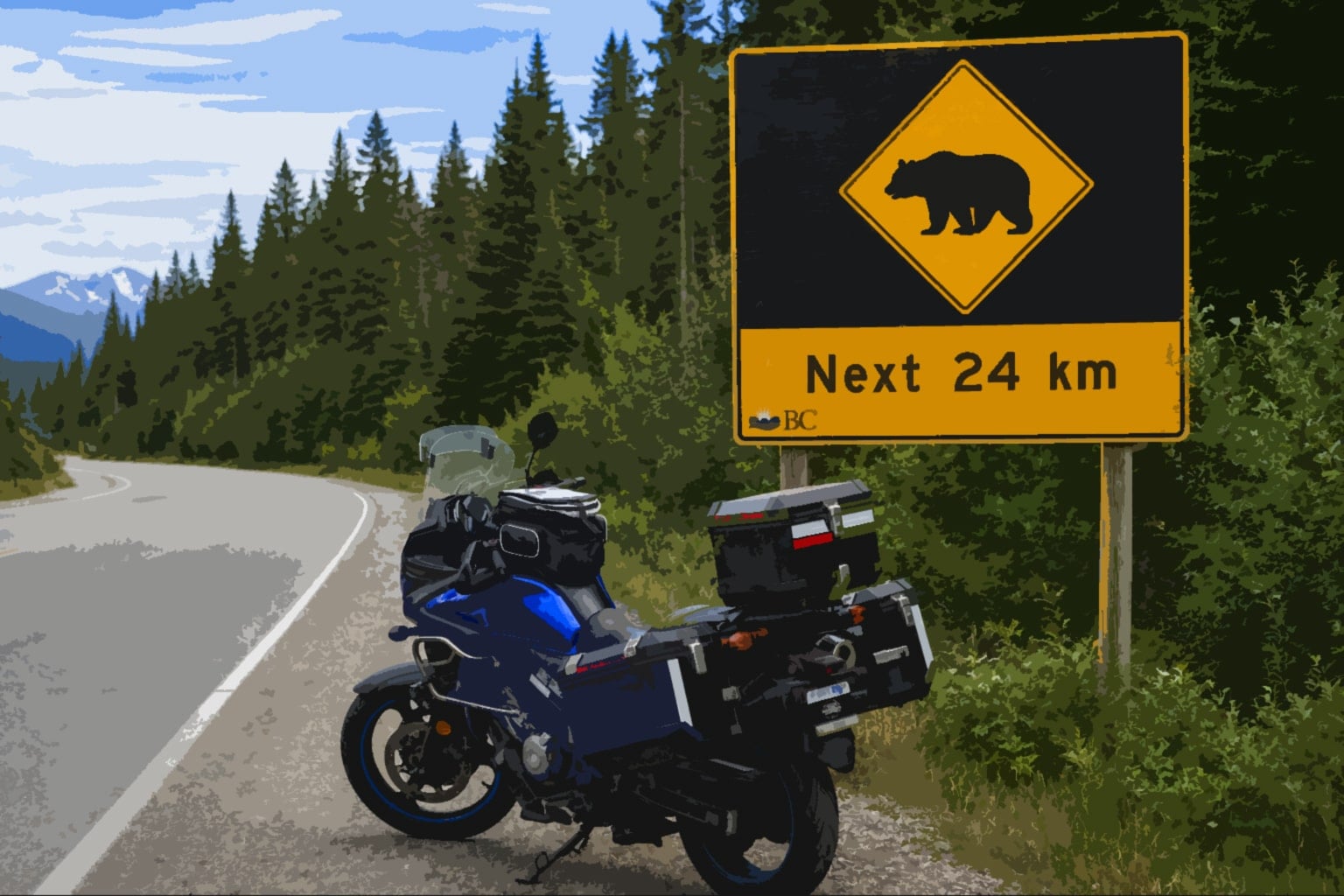
My goal was to camp across the country and the campgrounds I found in British Columbia were glorious. Unless you are from Ontario and grizzly bears have always been those big bears they have out in BC—never something that’d threaten your own existence.
This was not the first time that I woke from the ruckus of a critter, animal, or forest creature that had invaded my campsite—the same thing had happened to me in Northern Ontario, it was just the first time it might be a grizzly. I was awake—my senses on high alert.
Something had shown up hungry, and it was close to my tent. Too close. Was this the night I’d be gobbled up by an unknown beast? A mere morsel for a grizzly, perhaps. Drat. Why did I not have a Crocodile-Dundee knife to fend off my nocturnal foe? Sleep? Impossible. I realized a profound truth: The nighttime visitors always feel somuch larger and scarier than their daytime counterparts. I lay there, aping a corpse, hoping I wouldn’t be dessert to a beast’s nighttime feast. Eventually, it retreated into the forest, and morning came. The sun rose, and all was well with the world, at least, until I put my head down once again.
Lesson three: Always critter-proof your campsite before retiring. (And don’t let your imagination run wild.)
Safety
When I head out I take with me some assumptions. One is that I am leaving crime and bad people behind—because everybody knows that those are products of urban blight. Well, not necessarily. I ride a bike that is a little too tall for me. When I stop I have to check out the camber of the ground. If I try to put my foot down and it doesn’t hit terra firma I can tip over. But when I pay attention there’s no problem. Same thing. You don’t need to be paranoid, just aware.
During Covid I left a water bladder backpack hooked onto my bike while I took a short hike to see some waterfalls. When I returned from the 45-minute hike it was gone. Who would take a hydration pack during COVID? COVID! I mean, really?
When you are riding alone, one issue you are faced with is the safety of your gear when you are away from your bike. I have only ever had one piece of kit stolen—the water bladder backpack. So, not much to worry about. I just choose where I shop, and often try to camp or stay near the places I want to hike or visit. A little extra planning and I think I reduce the risk considerably, even when I’m riding solo. Lesson four: Don’t let your fear outpace the risk.
Depending on where in the world you are, “masked” bandits can have a different meaning. Here in Ontario, it’d probably mean raccoons. Elsewhere, probably their version of raccoons. Or something else—possibly worse.
In Mexico, beware of coatis (ko-wah-teez). Unlike raccoons they are diurnal—active during the day. And, although not particularly dangerous, they do forage in packs andcan strip down your bike or camp like a school of red-bellied piranha can strip the meat off a cow, leaving your gear strewn and your food gone.
And, of course, there is the homo sapiens variety. They are usually diurnal but can switch to nocturnal—especially when they are up to no good. Beware of them, too.
Lesson five: Good and bad don’t have borders. Be cautiously alert and know that it probably won’t be an issue. (And, be aware of what masked bandits may await, lest you face an inconvenient surprise.)
Solo or With Friends
There is safety in numbers. Quite true. But here I’m not talking about the added risk of being solo, I’m talking about the benefits.
A solo rider has something special going for them. They are like a flashing beacon to anyone camping nearby, or sitting at the next table in a roadside diner, or at the gas pump. Many people can’t imagine traveling alone because they would find it both scary and lonely. Their heart goes out to you. They want to help. Give you some company. (People are surprisingly nicer than I expect!) They like to invite you into their world. I have never once had a scary situation, but I have had many people invite me to their campsite, or home, to share a meal and even be put up for the night.
I suspect that people generally find it less intimidating to approach a single person, especially if they’re wearing bright yellow riding gear like I do. Think, Big Bird rides a motorcycle. Looking like a big moto-canary seems to entice people to come and talk. I am the antithesis to “scary biker”. And that’s the way I like it. Come and say hello.Even the big scary bikers do.
Lesson six: If someone asks. Don’t think. Say yes! Touring is way more than a curvy road or counting the day’s mileage. Shmuel shared a very important-to-him bottle of eighteen-year-old scotch with me because he wanted to. Richard and Andrea shared their campfire and a few beers and subsequently put me up at their house. You just can’t say no to that.
I Never Forget My Weapons
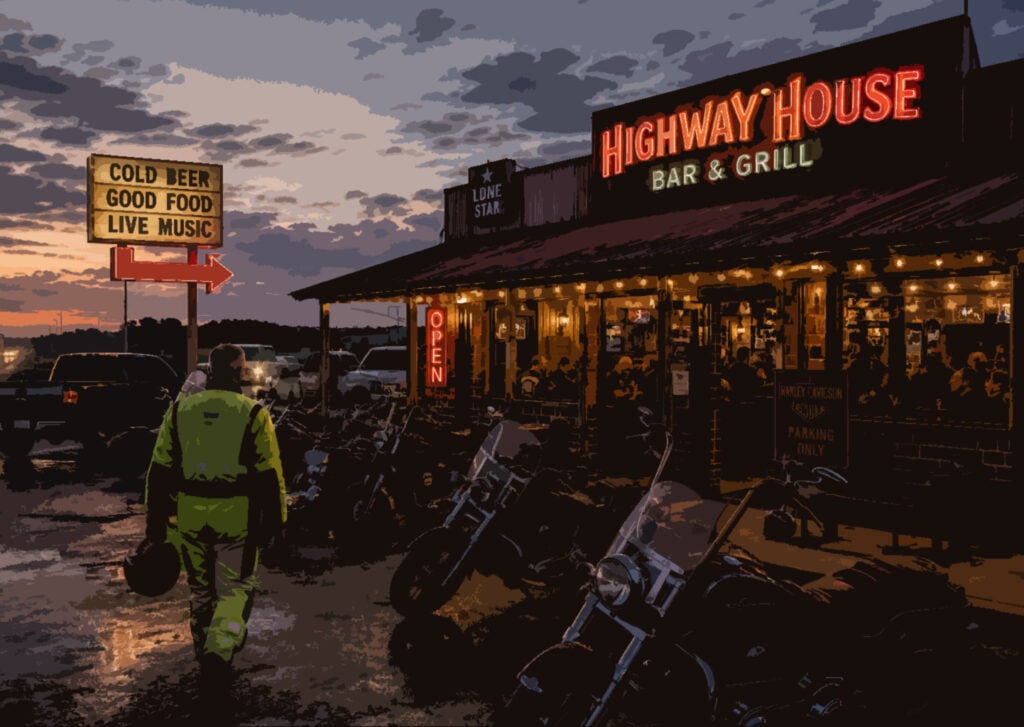
I had been riding for hours and I really needed to go, if you catch my drift. Lights, up ahead. Phew! Just in time. I pulled off, parked my bike, and in full hi-viz canary yellow touring regalia headed past all of the parked Harleys to the front door of the biker bar. I had to go so bad I’d have fought the grizzly that might have eaten me. As I walked towards the door a six-foot-six biker—probably named Tiny—stumbled out and looked right at me. I looked him square in the eye and said, “Doin’ alright mate?” “Great…great.” And he walked on.
Attitude, courtesy, friendliness, respect, goodwill—the weapons I always take with me. So far, they have never failed. I have always been treated the way I treat others.
Lesson seven: When in Rome, remember it’s their country, city, or town.
Parkinson’s Moto-Law
Parkinson’s Law describes the phenomenon that a project will expand to take the amount of time available to do the project. For our purposes, I re-worked it and called it Parkinson’s Moto-Law. It states that the amount of gear we take will expand to the amount of space we have to fill on our bikes. Add a tank bag: FILLED! Add front accessory bar bags—FILLED. Add a seat bag ROK-Strapped to the pillion seat—FILLED.
There are long lists of gear suggestions you should take. I tried taking a lot of it and dropped one whole duffle bag off at the bus station and had it shipped home by bus freight. I did not miss a thing.
Lesson eight: The challenge is not to take more, it is to pack less.
Murphy’s Moto-Law
I hijacked this one too. If something can go wrong, it probably will. Our moto version explains things like this: You can hit sand in a corner on an otherwise clean road and beautiful day and find yourself in the bushes. While this has not happened to me yet, it could. Since I am a solo rider, don’t keep an itinerary, and don’t report home to anyone, I have decided to buy a basic Emergency Beacon so if I do find myself injured and in the bushes somewhere, I can call for help.
This came to me mostly as I rode remote roads in BC and Northern Ontario. There were plenty of places where just going off the road would put me out of sight of passersby. If I was stuck there it could be days before I was found. Solo riding has taught me that you have to take a little extra precaution if you’re out there on your own.
I also take a fully equipped first aid kit.
Lesson last: Be prepared. But, hey! You’re on a bike. Everything in moderation, including moderation.
Is this everything I have learned? Hell no. Is this everything you’ll need to know? Not by a long shot. Heck. It’d be absolutely no fun whatsoever if you knew everything before you headed out. The fun along the way is in the obstacles you overcome. At the end of a long day’s paddle, you don’t sit around the campfire and talk about the calm lake you paddled across. You talk about the bushwhacking portage—the damn thing was supposed to be marked—you had to schlep across where you fell twice and you were sure you were being spied on by hungry bears. Getting out there to learn what the road has to teach is the fun part. Boldly go, where you have not gone before.
Ride safe and have fun out there.
– John Lewis

John is a passionate moto-traveller and motorcycle enthusiast who enjoys sharing stories that inform, inspire, and entertain. Specialising in motorcycle touring, safety, travel, or just about anything motorcycle-related, John’s insights, travels, and experiences have been featured in national magazines such as Motorcycle Mojo and The Motorcycle Times, as well as on various blogs and websites. When he is not riding or writing, he works as the service manager at a boutique motorcycle shop where he’s always ready to share a story or helpful tip.