Why Riding Like You’re Invisible Isn’t Enough
“Ride like you’re invisible.” We’ve all heard it. It sounds like great advice. The problem is that it has become a cliché. And as happens with all clichés, it has become trite.
Visibility is an essential building block of our survival. Absolutely. Riding with hi-vis gear helps. Adding an AdMore rear light bar improves our chances of not being hit from behind. I wouldn’t ride without one. Choosing road strategies and positioning to improve our chances of being seen by a driver—essential. These aren’t suggestions; they’re the basics.
But being seen is only half the battle. It assumes that if the driver sees us, we are safe. That belief lives in our Two-Wheel Filter along with the assumption they will recognize our speed, give us our legal right of way, or understand why we have to slow down to go over a wet construction plate or turn 45 degrees to cross a rut in the road. But they don’t and they won’t. It is simply not a part of their Four-Wheel Filter. Even if drivers see us, they don’t “get” us—the hazards motorcyclists face that they don’t, the physics of our cornering, or the sheer vulnerability of our position.
The Mercedes and the Gap
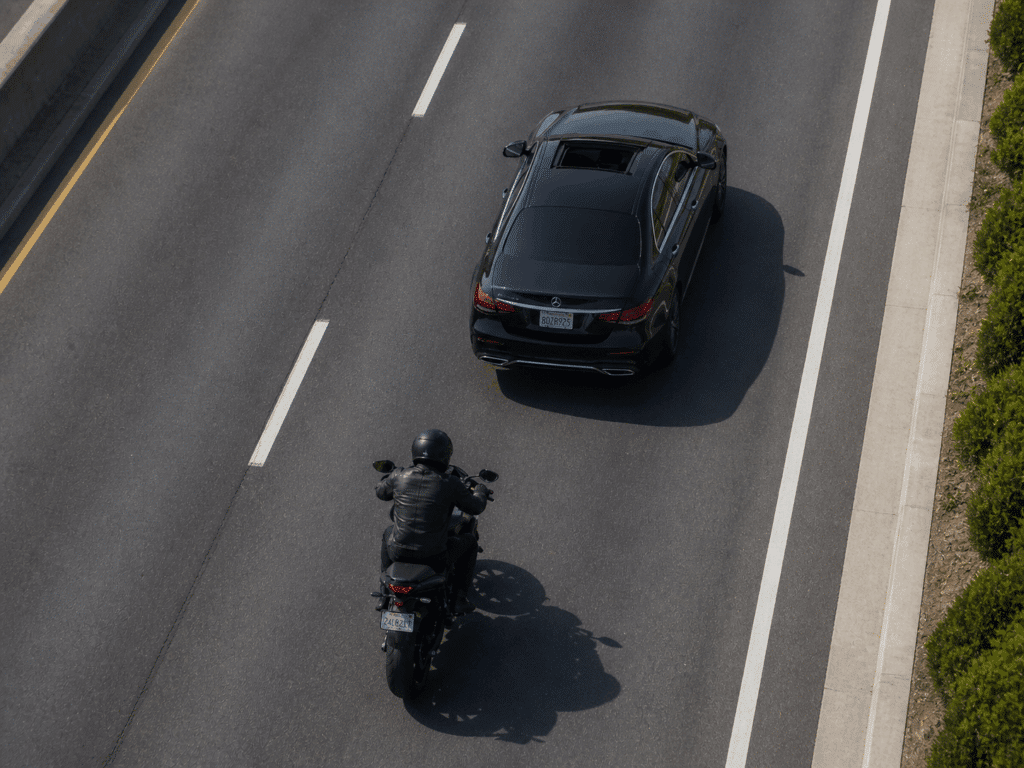
I was taking an off-ramp from a major highway—a rather sharp 90-degree turn that becomes an on-ramp for another highway. On a bike, these are the moments we live for. We gear down, enter slow, point the bike, and power out. I was wide on the outside, setting up my line to hit the apex.
Suddenly, a Mercedes decided she would pass me on the inside.
She saw me, but in her Four-Wheel Filter of the road, I was just a slow-moving obstacle on the outside, leaving a car-sized gap she was happy to fill. The Mercedes didn’t know that in about one second I would need the space she was in, and my speed would go from 60 km/h to about 120 km/h, ready to merge with another major highway. She was oblivious to the fact she was cutting off my only safe path through the turn.
I scrubbed some speed and let her pass. There was no point in getting angry. She was just operating on the only model she knew—her Four-Wheel Filter.
The Quebec Muck
On another occasion, I found myself in Quebec being waved onto a shoulder detour by a flagman. It was ten inches of tire-sucking muck right next to a ditch of indeterminate depth filled with water about four feet below the gully’s edge.
Street tires aren’t made for this. One wrong look—we all know we go where we look—and I was going to have a very “moist” day. I was focused, “pointing and gunning” it through the mire, trying to keep the bike upright.
Behind me, a guy in a pickup truck was losing his mind—honking, tailgating, and acting as if I was intentionally ruining his afternoon. Through his Four-Wheel Filter, the shoulder wasn’t even something to think about. He had no experience with how ten inches of muck affects the handling of a bike with street tires.
He wasn’t “blind” to me. He was blind to my situation.
The Reality Gap (aka Schematic Mismatch)
Psychologists call this a Schematic Mismatch—a mental blueprint our brains use to understand the world.
Drivers have a Four-Wheel Filter. It’s the reality they know. Their blueprint is built around 4,000-pound boxes. It’s an efficient model for them. It scans for other cars, looks for car-sized gaps, and assumes car-sized braking distances. It works perfectly for 99 per cent of their lives.
Riders have a Two-Wheel Filter—a world that includes lean angles, traction limits, and the knowledge that encountering gravel at the wrong angle can be a catastrophe. It often assumes that drivers will do the right thing and give the legal right of way.
The “friction” on the road happens when these two incompatible worlds intersect. The problem for us is that this friction is disproportionate. If a driver’s model fails, they get a dented bumper. If our model fails, we go to the hospital.
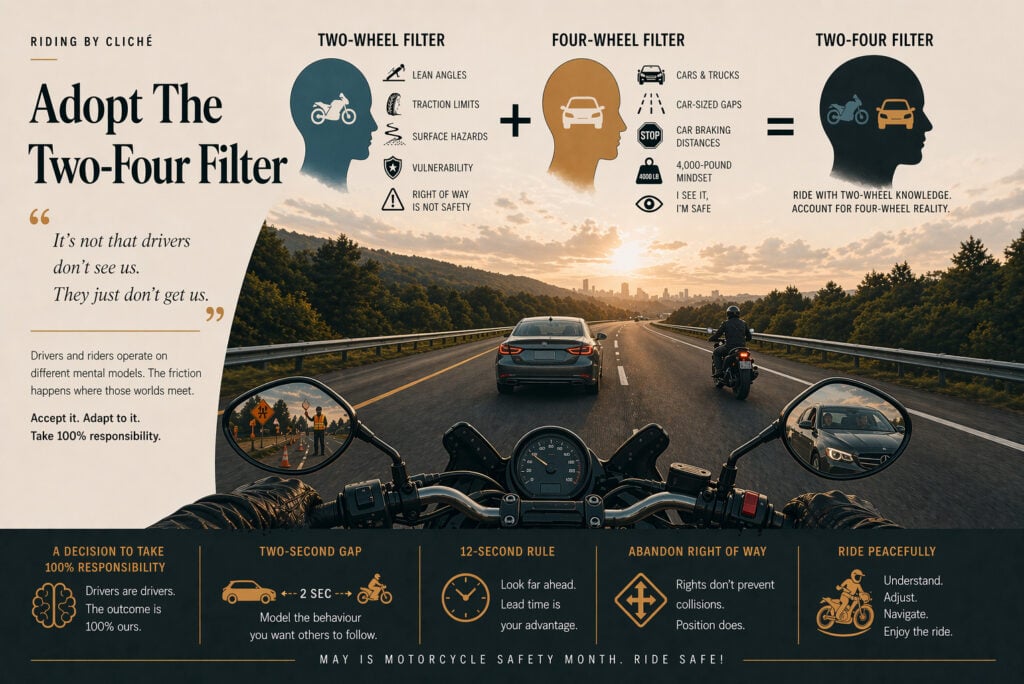
This is why “riding like you’re invisible” is too basic. It’s passive. What we need is a Two-Four Filter—a superior mental model that allows us to function on two wheels while simultaneously accounting for the unpredictable behaviour of drivers guided by their Four-Wheel Filter.
Adopting the Two-Four Filter
Adopting the Two-Four Filter is a decision to take 100 per cent responsibility. It’s the realization that drivers do not understand our reality, so the responsibility for the outcome is 100 per cent ours.
When you adopt the Two-Four Filter, your behaviour changes:
You Stop Taking it Personally: When a driver cuts you off or fills your safety gap, you don’t feel road rage. You don’t rev-bomb or flip them off. Why would you? You don’t get mad at a dog for barking or the rain for being wet. You recognize the Four-Wheel versus Two-Wheel mismatch. They are just operating according to their Four-Wheel Filter. By removing the emotion, you free up the bandwidth to actually ride.
Modelling Behaviour: I’ve found that if I maintain a disciplined two-second gap in front of me, it isn’t long before the car behind mirrors my behaviour. This isn’t just luck. Humans tend to follow what looks like the norm. In my case, they often fall into the same rhythm and spacing. By holding that gap, I’m setting a pace that the driver behind me mirrors. Who knew?
The 12-Second Rule: By looking far ahead, you start to see how traffic patterns unfold. For example, you can see the driver waiting to turn left and realize that you will not be in their line of sight by the time you get there because of a truck in the lane beside you. The driver’s Four-Wheel Filter will lock onto the truck, and the moment that “big box” passes, their brain will signal that the space is empty and it’s time to turn. No problem. With our Two-Four Filter, we know this. We simply adjust our speed to stay protected by the truck. We use our lead time to take ourselves out of a situation the car driver didn’t even know he’d soon be in.
You Abandon “Right of Way”: The Two-Wheel Filter knows who has the right of way. The Two-Four Filter doesn’t care. Right of way is a legal concept; physics is a reality. If my “Two-Four” scan shows a delivery truck with its left turn signal on, I position myself and adjust my speed for when a waiting car pulls out to pass it. I don’t wait to see if they do, or if they’ll respect my rights if I’m in that lane; I’ve taken them out of the equation.
The BoB Factor and the Journal
Of course, we have to be honest: the friction isn’t always the driver’s fault. There are plenty of BoBs—Bozos on Bikes. These are the riders who ride with a chaotic model, splitting lanes at high speeds or acting unpredictably. They break the Four-Wheel Filter’s expectations in a way that makes the road more dangerous for all of us.
The Two-Four Filter requires a level of discipline that many BoBs lack. It requires a system. Personally, I use the UK’s IPSGA model—Information, Position, Speed, Gear, and Acceleration. It’s a cycle of constantly taking in information about the drivers around me—all functioning based on their Four-Wheel Filter—and adjusting my position and speed accordingly.
The Only Answer: Taking Total Responsibility
Riding with a Two-Four Filter is, ultimately, a more peaceful way to live.
When you accept that drivers will be drivers—that they are efficient, learned-experience machines that simply don’t have a “motorcycle setting”—the stress of riding disappears. You stop fighting the world and start navigating it.
Sure, “ride like you’re invisible” is a part of the two-wheel model. It’s a good starting point. But the Two-Four Filter includes abandoning blame and taking full responsibility for every second you are on the road. It accepts that drivers don’t know and it doesn’t expect them to.
Drivers simply don’t come from a world that teaches them what we wish they knew. They never will. And once we truly understand that, we have no one to blame, no stress to carry, and a lot more room to enjoy our ride.
May is Motorcycle Safety Month. Ride safe!
– John Lewis

John is a passionate moto-traveller and motorcycle enthusiast who enjoys sharing stories that inform, inspire, and entertain. Specialising in motorcycle touring, safety, travel, or just about anything motorcycle-related, John’s insights, travels, and experiences have been featured in national magazines such as Motorcycle Mojo and The Motorcycle Times, as well as on various blogs and websites. When he is not riding or writing, he works as the service manager at a boutique motorcycle shop where he’s always ready to share a story or helpful tip.